Friday, March 5, 2010


part 3

AZUL GRANDE

"Roll up your windows, and lock your doors," said Gene as we drove into the outskirts of Belize City. Mike, Gino, and I locked and rolled quickly. We'd read there was a serious danger of being robbed in Belize's largest city.
We actually expected to leave town with more money than we had on arrival, thousands more. The money would come from the sale of Azul Grande, the big blue van we had driven from California through Mexico, Guatemala, Honduras and Belize. Selling an imported car is legal in Belize, and the capital city is where the official appraisal is made and the taxes paid. The tax is based on the appraised value, so we hoped for a low valuation.
We had a plan for protecting ourselves and our possessions while looking for lodging in this dangerous city: two of us would check out the hotel while the other two remained with the van. We wanted a telephone in our room, a feature that wasn't standard in that country in 1992. We needed to call all the people who had shown an interest in buying Azul Grande.
As soon as we'd crossed the border from Guatemala to Belize, we'd put a sign in the back window in Spanish, "Se Vende," and English, "For Sale." During the following month, half the population of the small Central American country had inquired about the particulars. The asking price was $3,500 U. S., and the buyer would pay the taxes.
We pulled up in front of a hotel and were met not by a doorman or parking attendant but by a ten-year-old boy with a bucket in his hand. "Wash de car man?"
"No," said Gene. "We may be here only a few minutes." As he and I got out of the van, he said to our brother Mike and our thirteen-year-old son Gino, "Lock and roll."
Mike sang a barely altered chorus from a song by “The Rolling Stones" - "I know: It's only lock and roll, but I like it, like it, yes I do." Mike was a red head with a mustache, a strong man in a fragile body. His neck no longer turned independently of the rest of his body. He had two artificial hips, trouble with his knees, and walked with the use of a cane that he now held at the ready as a weapon. He didn't have to hold it long before we returned.
"Too expensive," I said. "It's not worth $30 a day extra just to have a phone in the room."
"Can we go eat as soon as we find a place to stay?" Asked Gino. He has my coloring: dark hair, eyes, and skin and his father's deep voice and muscular physique. He was large for his age with an appetite to match.
"I'm hungry too," said Mike. Those two are always hungry.
Our next stop, the Mopan, is a landmark house on Regent Street with a large screened porch across the front. Like most of the buildings in Belize City, it looked a bit shabby. We were following our looking-for-lodging-in-a-dangerous-city routine. As Gene turned to lock the door on the driver's side, a man came up behind him and tapped him on the shoulder. Gene whirled on him with every muscle in his body tense, the veins in his bullish neck showing. He was over reacting because the touch had caught him by surprise when he thought he was being alert to danger. We called Gene our muscle because of his powerful upper body and because he took his role as our protector seriously. Ordinarily, his blue eyes had a calm innocence that he was perfectly capable of exaggerating when it suited his purpose, but now his eyes were blue flames.
The man took a step back. "I just want to wash your car."
"Stay away from my car."
"I’m only trying to make an honest dollar," he called after us as we walked away.
They didn't have phones in the rooms at the Mopan, but the owner said Gene could use her office phone and that she'd send someone running up the three flights to get him if he received calls. We got the only room with a view of the bay, #303, at the end of a wide covered verandah. We brought our luggage and two folding lawn chairs up from Azul Grande. Mike stretched out on the bed for a few minutes while Gino set the chairs out on the verandah where there was already a bench. I unpacked the toiletries and set up the coffee pot. Gene made a quick repair on the ceiling fan. "Okay," he said. "Now we can go eat."
Waiting outside is the car washer. "This machine really needs cleaning," he said.
He was right. The mud of many rivers and the dust of many miles made the van more gray than blue. The washer man was old, and Gene was feeling mellower now that we were settled. He said, "I'll let you wash the car later, but not till I tell you, okay?" He explained to us, "I want the van dirty for the appraisal. It might make it lower."
An armed guard stood outside the entrance to Mom's, our dinner destination, so we knew Azul Grande was safe. Mom's is a funky old favorite with travelers from the United States, recommended to us by a friend. Besides tables and chairs, there is a lunch counter. Electric fans keep the warm air moving. Gene and I order Mexican food and Belikin's, a local beer. Mike is the most adventurous. He has Gibnut, a Creole specialty. Also known as Paca, Gibnut is a herbivorous rodent about the size of a badger. Although it is served with a tiny bit of fur still attached, it is fall apart tender and very tasty, somewhat like pork roast. Gino orders a hamburger, French fries, and a vanilla milk shake. The shake is thick but not too thick. His fries are golden brown. The meat tastes like hamburger. The bun is homemade, fresh and fragrant, and every condiment of choice is available. He’d been served enough disappointing burgers in our travels that he thought this meal was a minor miracle. We all agreed we'd return to Mom's.
Back at the hotel, Gene began to call the men who'd been serious enough about buying Azul Grande to give him their phone numbers. The only one who lived in Belize City was the Reverend Browning. We'd met him in Punta Gorda, a simple village on a narrow road that hugged the water. Reverend Browning visualized eight of his flock being transported to church services and socials in "the Van of God." The Reverend wasn't home. Gene left our number.
Rodney of Dangriga was home. Punta rock played in the background. He was still interested but hadn't got the money together yet. "You have 24 hours," Gene said.
The man from Crooked Tree, where we'd gone to see rare five feet tall Jabiru Storks, didn't have the money either.
Zandy, whom we'd met at the archeological ruins of Altun Ha, wanted the van for his tour business. He offered $2,000.
Gene said, "I'll drive it back to California before I'll take that kind of loss."
Sitting outside our room, sipping Belizian "Parrot" rum, Gene admitted we didn't have time for the long drive home. Besides, Azul Grande was purchased specifically to sell in Belize. Parts were easy to get. It had the high clearance needed on the bad roads.
Mike said, "If you take a loss, I'll absorb some of it. It'd still be cheaper than renting a car would have been."
"Maybe not at $2,000."
"You'll get more than that."
"I don't know," said Gene. "It's a short list."
"It only takes one," said Mike.
"I'm hungry," said Gino.
"We have a tin of sardines left," I said.
"No thanks."
"Metamucil?" offered Mike.
"No," said Gino. "I'm trying to quit."
Someone was running up the stairs. A young man appeared at the end of the verandah. "There's a call for Gene," he said breathlessly.
"I'll bring you back something," Gene told Gino. Mike waved his cane. Gene nodded to him, understanding that he wanted a snack too. In ten minutes, he returned with soft drinks. "This is all I could get. The call was from the Reverend. He's coming by for a test drive in the morning."
After the drive, the Reverend offered $2,500. Gene held out for the full $3,500. Reverend Browning said he'd ask for guidance from the Lord and money from his congregation. They'd talk again.
In between Gene making and waiting for phone calls, we devoted a good deal of our time to dining. We liked to sit out on the covered porch of Four Fort Street, an elegant old home converted to a restaurant with a few rooms to rent upstairs. They are known for their desserts. Homemade soursap ice cream had an unusual sweet and sour flavor. Sour sap fruit is the size of a grapefruit with conical but harmless horns on the lime green exterior. We had plenty of time to ask to see the fruit or to discuss how they made the cashew jam that was spread between fresh baked sugar cookies. It turns out, the cashew has both a fruit and a nut.
After visiting the Baron Bliss Institute, we had pretty much exhausted the sights to see in the city, but we couldn't spend all our time eating. We used our imaginations and walked from the Mopan to a horror movie set of a cemetery with overturned headstones, overgrown grounds, and out of control mosquitoes. "You'd think they'd take better care of this place," said Mike. "People are dying to get in here."
We shopped for music tapes of Punta Rock and photographed a store window that displayed towels, disposable diapers, women's clothing, and condoms, all in one window. We crossed the Haulover Creek swing bridge many times and never saw it swing. Our filthy vehicle elicited such a look of disapproval from the doorman at the fancy Fort George Hotel that we thought he might deny us entry, but he didn't. We swam and lunched poolside overlooking the bay. Locals hung out at the public pier across from the hotel just as they did in Beka Lamb, the novel I was reading by Belizian Zee Edgell.
We still practiced the precautions of paranoia, but it seemed that the notorious muggers and pickpockets had turned to a life of car washing. Gene gave the old man outside our place some money to keep an eye on the van.
Three hundred flights of stairs later, Gene had a deal. Reverend Browning had come up with $3,500, but out of that, he had to pay the taxes. What was left over was ours. Gene and the Reverend would take the van in for the tax assessor's appraisal the next morning. We decided to celebrate by making our return visit to Mom's. "I'm getting the hamburger this time," said Gene.
"Me too," said Gino. "And another shake."
"I think I'll get Gibnut," I said.
"To make the musical chairs meal complete, I'll have to get Mexican food," said Mike.
But there were no buns for burgers, no ice cream for shakes, and no Gibnut either. "Not even a small piece of fur?" asked Mike facetiously. The waitress was not amused. It was Sunday, and she'd rather be out at the cays or at least down at the pier.
"You'd think they'd get extra supplies on Saturday to tide them over till Monday," I said.
"Not all mom's are as organized as you," said Gino.
The meal was seasoned with too much disappointment to be a complete success, but at least we weren't hungry when we stepped back out on the street. Gene stopped in mid-stride. "Oh my God," he said. We all stared in shock at a sparkling clean Azul Grande. A raggedy Rastafarian with dread locks down to his bare shoulders stood next to the van, waiting for praise and payment. Gene turned on the armed guard. "How could you let this happen? What kind of a guard are you?" Dumfounded that anyone would be so upset about their car being washed, the guard didn't respond.
Gene looked like he was going to cry. He said, "I can't give him anything. Thanks to him, that's probably the most expensive dinner we've ever had."
"It could have rained," I said.
"But it didn't," he said. "And what am I going to tell the old man on Regent Street?"
Mike slipped Rasta man some money and said, apologetically, "He did a good job."
"Yeah," said Gene despondently. "The van looks great."

At the tax appraisal, Reverend Browning pulled Gene aside and asked, "Why'd you wash it?"
"I didn't." Gene told him the story.
The Reverend laughed. "If a car wash is the worst thing that happens to you in Belize City then the good Lord must be looking after you." He paid $600 in taxes. We left town with $2,900 and the knowledge that Azul Grande's dirty days were over.

*****************************

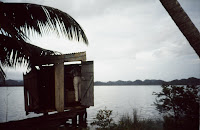
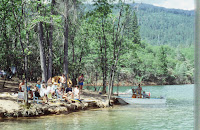
photos: first – Gino, Mary, & inspector at Guatemala/Belize border, second – another road less paved, to Punta Gorda, Belize,

Thursday, March 4, 2010


Part 1 - Belize

DRIFTING TO HONDURAS


Many of our friends and family thought we were crazy when we decided to drive from Northern California to Belize by way of Mexico, Guatemala, and Honduras. It was a drive some of our peers made in the early 70’s, but when civil war and horror story violence broke out in Guatemala, that country fell off the tourist map for Americans. By 1992, things had calmed down, so Gene and I decided to make the longest road trip of our lives. Our youngest child, Gino, would accompany us. He would celebrate his first teenage birthday on the road. Our friend, Michael of Venice, would meet us at the great archeological ruin of Tikal and continue traveling with us through Belize.
When my sister, Barbara, and her husband, Phlete, drove the same route to Tikal, back in the day, the road was not paved. A black panther ran across the road in front of them. After all those years, the road still is not paved, but there were no panther sightings. We were warned that the road was not safe, but the dangers were guerillas or army. It was too late to turn back. It was illegal to sell the car in Guatemala, Honduras, or Mexico. We wanted and needed to get it to Belize. We decided, if someone tried to stop us, we would floor-board it and get away from them as fast as possible. The plan was concocted before we crossed the Rio Dulce and said adios to any hint of pavement. Things got so much slower then that an able bodied adult could run as fast as Azul Grande, our vehicle, and if they wanted trouble, trouble there would be.
A flat tire turned out to be our only problem, and we were successful in getting a room for four at the Jungle Lodge, right at the archeological site of Tikal. Our guide book said all the lodgings at the site were over priced, but we wanted to be there for the birds at sunrise and sunset.
This was not the first time we’d met up with Mike at an exotic location, and it was not to be the last. We’ve had foreign rendezvous with others, too, and it is always exciting. Whatever Mike lacks in physical dexterity, he makes up for with a flexible frame of mind and a sense of adventure. We climbed to the top of Mundo Perdido at daybreak and were rewarded with amazing wildlife sightings from this flat top pyramid. We didn’t see the elusive jaguar, but we saw monkeys, toucans, macaws, coatamundi’s, oh so much. We wandered around the huge site the rest of the day in an archeological ecstasy. We could have spent much longer, but Belize beckoned. It was a new country with more archeological ruins, wildlife, and snorkeling.

We found the mainland community of Placencia, Belize, at the end of a peninsula. On the approach, there is a laguna on one side of the road and the Caribbean on the other with only a few palm trees in between. The road runs behind the community but not through it. The main thorough fares are narrow sidewalks and pathways in the sand. One must get out of the car and walk around to find a place to stay or eat. From one end of town to the other is no more than half a mile.
We were told by two travelers we met elsewhere to eat at Brenda’s. It turned out to be next to where we were staying – all three tables. They sat directly on the sand, under a thatched roof, looking through hibiscus and palms to the water. Brenda was a huge black woman. Her menu was a small chalkboard which listed, “fish, shrimp, conch.” I ordered shrimp, and she said, “No shrimp.” So, two of us got fish, the other two conch. Conch is very much like abalone in taste and texture. Both come out of beautiful though dissimilar shells and need to be pounded to be tender. The fish and conch were accompanied, as practically every meal in Belize is, by coleslaw and Belizean rice and beans. The rice is cooked with coconut. Sometimes it is mixed with the beans; other times they’re served separately. It was all excellent.
Before we were through, two men from England arrived and asked if they could share our table since there was no place else to sit. We agreed, and Brenda promptly brought them plates of shrimp. “What’s your secret?” I asked.
“We ordered earlier,” was the reply.
“You want shrimp tomorrow?” asked Brenda. “No problem man. Anything you want, just tell me man.”
“Could you make up conch fritters?” I asked.
“No problem man! I’ll have some conch fritters and shrimp for you guys tomorrow night.”
On the short walk back to our lodging, it amused me to think we were walking to paradise. That was the name of the place we were staying – paradise. It wasn’t a hotel, motel, Bed and Breakfast, and it sure wasn’t paradise. Our two rooms were basic Belizean – mismatched, tattered bed linens, no closet, trash can, TV. The shared bath was in a separate building out back. A deep screened-in porch across the front faced the Caribbean. Brenda’s was next door, and at the end of a pier in front was an open air, thatched roof bar. I always want to be right on the beach, to go to sleep and wake up to the sound of the surf, to zone out just watching the waves come in and the waves go out. Between our porch, the bar, Brenda’s, and the picturesque community of Placencia, maybe it was paradise after all?
We weren’t able to get out on the water the next day because the weather was stormy, so we explored the village and played many games of Triominos which our daughter, Fawn, had given us for the trip. Gino did some of his independent study homework. Finally it was time for dinner at Brenda’s, and it great.
In no time at all, everyone knows what you’re up to in Placencia. Brenda asked, “You guys want some breakfast before you go snorkeling tomorrow? I’ll make you some sandwiches to take too.”

Morning broke clear and bright. We were excited that we got to make our snorkeling trip. Although Belize has the second longest barrier reef in the world, you can’t reach it from the mainland shore. A boat ride is required, or you need to be staying on an island.
After breakfast, we go down to the pier with our gear and the bag lunches Brenda prepared for us. The sandwiches were scrambled eggs, bacon, and tomato, a Caribbean specialty. We would have breakfast again for lunch.
The two guys who shared our table the first night were going out on the boat with us. The captain of the boat, Franklin, might not look any older than Gino if he didn’t have a cigarette dangling from his mouth. Gino is actually taller than Franklin, but he is also now taller than his Dad by a fraction. We just noticed this a few days ago, and Gino declared it the happiest day of his life. The previous happiest day of his life was also on this trip when he and Gene found a copy of the Sports Illustrated swimsuit issue on sale on one of our many stops in Mexico. Gene was tactful enough not to admit to such elation himself.
So here I am, not magazine material, but still looking pretty good in a bathing suit and feeling even better at the prospect of a boat ride, seeing some beautiful fish, and having a picnic lunch on a little tropical island.
Franklin takes us to an island inhabited only by palm trees. It is so close to the reef that getting into the water without getting cut by coral is tricky, but the fish are plentiful, varied, and beautiful. When we get out to rest and have lunch, Mike gets a nasty coral cut on his shin.
No sooner had we finished our picnic than a sudden, torrential rain descended. When it let up a bit, Franklin said, “We head back now.” None of us argued with him.
At first, everything was fine out on the water in the boat, but then the sky and the water became an identical silver gray. There was no horizon, no differentiating between the sky and the water. Franklin turned off the motor. “I’ll save the gas for when I can see to get us home,” he said.
Now I realized how deserving we were of the name of our group of friends from college days – The Fools. Fools do not concern themselves with whether the boat they are going out on has a two way radio, flares, lights, extra gas, paddles, or buckets for bailing. We hadn’t insisted on life vests, and there were none. We started off with food, but we’d already eaten that. We hadn’t even demanded an adult to captain the boat. Gino was the only one on board younger than our captain. – Our very nervous captain.
The dad, the Boy Scout, the adult in Gene kicked in, and he leaned in close to the young man. “Don’t worry,” he said. “Everything is going to be alright.”
Franklin nodded.
Gene asked, “If the wind keeps going in this direction, where will be end up?”
Franklin said, “Honduras.”
So: we’re drifting to Honduras. We’ve already been to Honduras, but we drove rather than drifted. It was a long dirt road from Guatemala to Copan, Honduras. There are many major roads in Central and South America that are unpaved. Traveling them is almost as slow as drifting, but drifting to Honduras is not as scary as drifting out to sea. I don’t think they have sharks in the Caribbean, and I’m not going to ask. The party atmosphere has dissolved onboard, but nobody is panicked. We are cold but only in an uncomfortable way, not a life threatening manner.
“Does anyone have water?” asks Michael.
Before anyone answers, Gino calls out, “Look! There’s an island!”
Franklin starts the boat right up and heads for the island. “I know this place. We are not far from home.” There is a one room cabin on the island that we all crowd into. We barely fit. Franklin lights a cigarette. Everyone but Gino bums a smoke from him. We haven’t smoked in years, but this seems like a good occasion to make an exception. We probably wouldn’t object if Gino had one. Within half an hour, the weather clears. It isn’t blue skies and sunny, but it is clear enough for Franklin to steer a course back to Placencia.
As we walk past Brenda’s on our way back to Paradise, she calls out to us, “Hey, man! I’m barbequing chicken tonight.”
“Sounds good. Count us in.”
After getting into dry clothes, we walk out to the thatched bar at the end of the pier in front of Paradise. We drink and play Triominos until time for dinner. Tomorrow we leave Placencia for another adventure.


photos: #1 - Gene & friend atop Mundo Perdido, Tikal. #2 - Gene, Mike, & Gino in front of Temple 5, Tikal. #3 - partial map of Placencia. #4 - islet off Placencia.

Wednesday, March 3, 2010

Gentle's Cool Spot


GENTLE'S COOL SPOT

We were bumping and bouncing around Belize in Azul Grande, the big blue van we'd driven from California. My husband, Gene, and I, our thirteen-year-old son, Gino, and our brother, Michael, were looking for archeological ruins and wildlife.
A fellow traveler told us a man in Gale's Point could show us the rare manatee. We got out our map and found Gale's Point to be a little finger of land at the southern end of Manatee Lagoon, south of Belize City and north of Dangriga. According to our guidebook, the only place to stay was an expensive fishing lodge, but, since we'd been roughing it, we were ready for a hot shower, a private bath, or both.
The many glowing articles we'd read before our journey about ecotourism in this Caribbean country hadn't prepared us for the wobbly nature of their tourist infrastructure. With a few exceptions, nice comfortable accommodations were expensive. There was usually no range of choices. Travelers like us with more of a sense of adventure than a bankroll became intimately acquainted with threadbare linens that are not turned down at night or made up in the morning. We often felt in Belize that we weren't getting a good lodging value for the money spent, but there were always compensations. Seeing an anteater on a sunrise hike in Cockscomb made up for the ferocious insects that swarmed our ankles as we walked from the bunkhouse to the outhouse. Swimming with spotted eagle rays off South Water Cay made up for the lack of electricity and hot water in our $100 a day beach cabin, but it wasn't until Gale's Point that we realized how much our travel dollars were buying. We paid more than at a camp site, but we didn’t have to set up a tent or blow up an air mattress, and we got to see fabulous wild life and beautiful places.
The village had no telephone service, and there was no answer on the lodge's two-way radio. We decided to take a chance on arriving without reservations and pointed Azul Grande toward the manatees.
We were on a trip back in time. The road to yesterday was hard and slow, unpaved, unsigned, with a river crossing that didn't include a bridge. Grass grew between the two dirt tracks that bisected the peninsula of Gale's Point. No need to worry about street names. There was just the one road with humble homes on stilts scattered along either side. Electricity to the village had only been operating one month. There was no restaurant, no store, and, as it turned out, no lodging. The fishing lodge had closed. It was 5:00 p.m. and hours from anyplace else to stay. Azul Grande would sleep three but not four. We had sleeping bags but no tent. None of us wanted to sleep on the ground because since we'd been in Belize, we'd already seen two of the most poisonous snakes in the world: a colorful coral snake at Crooked Tree and the venomous viper with a lance shaped head, the fer-de-lance, near the Thousand Foot Waterfall. No. We didn't want to sleep on the ground.
We retreated to the only commercial establishment in the village, "Gentle's Cool Spot." A cool spot in Belize is an informal cafe. "Gentle's" had six tables with chairs in an open-air area with a roof. Like everything else in the village, it was on that one unpaved road. Most cool spots serve food and drink, but "Gentle's" only served soft drinks and Belikans, the beer of Belize. No place to stay and no dinner either. We were all hungry and disappointed, but only Gino and I whined. Mr. Gentle said there was a man named Chip who had two beds we could probably use. "How will I find Chip?" asked Gene.
"He's a tall dark man,” said Mr. Gentle. Gale's Point is a community of blacks, and all the men, and women too, are tall and thin. So we drove along asking every man we saw if he was Chip. Since the population was less than 300, we found Chip. He agreed to rent us his beds. Gene and Michael, ever gallant, wanted Gino and me to have the beds, but we chose the van. We didn't inspect the beds and then make the choice. Perhaps we preferred the van because it was more familiar, almost a home on wheels.
Mr. Gentle's wife had agreed to serve us "tea" when we returned. Instead of seating us at one of the "Cool Spot" tables outside, we were ushered into the family kitchen. Rather than tea, she gave each of us a cup of boiling hot instant coffee. Gino looked at me questioningly. I shrugged slightly. I wasn't going to fuss at him if he didn't choose this time to start drinking coffee. In the center of the oilcloth covered table, she placed a bowl of pureed corned beef and a large round loaf of bread that she'd baked herself. They called the bread a "Creole bun." It had coconut in it and was delicious. I wondered if Mr. Gentle's large family had to forgo this tasty treat in order to feed us hungry travelers.
It wasn't a great surprise to find out that Mr. Gentle was the manatee man. He agreed to take us out in his boat early the next morning. There was absolutely no doubt in his mind that we'd see them.
Chip's place was across the road from the town pier. We took a bottle of chilled California Chardonnay from our ice chest out to the end of the pier and settled down to watch the night. With places to sleep, food in our stomachs, and a promise of manatee sightings, our spirits were lifted. Now we noticed how magnificent the coconut palms and spreading mango trees were, with more fruit than the inhabitants could consume. Every home had a view of the lagoon, a lagoon so shallow there'd never been a drowning in Gale's Point.
Now we could appreciate that Chip would give up his own bed for the night and sleep in a hammock. The other bed he was renting us belonged to their Peace Corps volunteer who was away. They were crazy about their Peace Corps worker in Gale's Point. She was teaching them that protecting manatee rather than eating them would help attract tourist dollars to their village, a hard lesson for a poor fishing village to learn considering a male manatee may weigh over 1,000 pounds. That's a lot of food. Our presence was proof that the Peace Corps worker was right.
The United States Peace Corps, the Audubon Society, and the World Wildlife Fund have all been instrumental in educating the people of Belize in the advantages of ecotourisim. Mr. Gentle was in the process of building a very basic cabin to house future tourists. The people who stay in that cabin will pay for more than marginal accommodations. They'll be contributing, as we were, to the survival of a special spot and species. If the tourist dollar helps Belizians protect their monkeys, coral reef, pyramids, birds, jaguars, and manatees, then the traveler has a bargain, and so does the environment.
We watched a full mango moonrise. The reflected moon quivered on the still waters of Manatee Lagoon. Silence settled on us like a soft feather comforter. It was the quiet of the wilderness, those places far from televisions, VCR's, tape decks, dishwashers, cars. Azul Grande was the only car in town that night. Soon the accouterments of electricity would be there too. We weren't really in the wilderness. We were in a place caught between yesterday and today, and we felt fortunate to be in that place.

When we met Mr. Gentle for our boat trip, he said sadly, "It's a bleaky morn."
Gene looked at the overcast sky with a frown and asked, "Will that interfere with us seeing the manatee?"
"Oh, no," Mr. Gentle assured him. He launched the boat, and we began our search for the herbivorous, docile, shy creature sometimes called a sea cow. At first, we thought Mr. Gentle was going slowly because we were searching, but he explained that one of the greatest threats to the manatee is boat motors. The big guys can't swim fast enough to avoid a boat moving at high speed.
Fifteen minutes out, he turned off the motor. We could see land but weren't near shore. "Now we will see the manatee," he said. Silvery Tarpon leaped around us. Two or three at a time were in the air. Were they taunting and tempting us? Did they miss the sport of evading a fishing lure? Or were they celebrating the closing of the fishing lodge? We were so enchanted with the sparkling silver spectacle that we were almost startled when Mr. Gentle said, "That is he." Mr. Gentle pointed a long finger at a large dark bulbous form just under the water's surface. The manatee was fourteen feet long and very near the boat. He stuck his nose out of the water, took a breath, and, with a stroke of the two paddle shaped appendages in front, disappeared. Manatee's are mammals and must come up for air every ten minutes, but what's unique about them is that they like to return to the same spot to breath. It's their version of "Gentle's Cool Spot." Now we knew why Mr. Gentle had been so certain we would see them.
We observed the manatee long enough for me to become convinced that they couldn't possibly have inspired the legend of the mermaid, as some sources say. We'd lost count of the number of noses that had surfaced when Mr. Gentle said, "Now we will see the birds."
That was the first I'd heard of birds on that particular outing, but we were always interested in wildlife. As we motored along, Mr. Gentle pointed out wild orchids in bloom and a long snake draped along a bare tree branch. He called the snake "walla."
When we reached tiny Bird Island in North Lagoon, he said, "This is what you came to see." Hundreds of white ibis, snowy egrets, and egret chicks were nesting together on the branches of low growing trees, the chicks as fluffy as dandelion puffs. "They're just so pretty," he said and repeated, "This is what you came to see." It was funny because it wasn't what we'd come to see. We hadn't known about the nesting birds, and we wouldn't have seen them if it wasn't for Mr. Gentle, a man who cared for many families: his own, the manatees, the birds, and the travelers.
"Cool," said Gino, the ultimate current compliment from a teenager. Indeed, there was more than one Gentle’s Cool Spot.
photos: #1 - Mr. Gentle & kids at his "Cool Spot." #2 - Crossing a river without a bridge. #3 - Our outhouse at Chips.

Friday, October 9, 2009


BLACK-EYED G AND THE PEA PICKERS

We sat around our kitchen table, reading the Corpus Christi Caller Times newspaper and drinking coffee. Mother was the only one of us who still lived in the house, but my sisters, Barbara and Doris, and I, still thought of it as ours. It was the place we had lived from the day we were born until we went off to school and points further down the line, and we tried to reunite there for a visit every summer.
Mother exclaimed, "Here's an ad for a place in Aransas Pass where you can pick your own black-eyed peas,"
Barbara's husband, Phlete, came in the back door while Mother was speaking, and said, "Mary and Gino didn't come all the way from California to Texas to spend vacation time picking peas." We females all looked askance at his statement. "Oh. Is this a girl thing?"
"Probably," said Doris. "Among hunter/gatherers, I think most of the hunters were men and most of the gatherers were women. We must go gathering."
"Besides," I said, "the only fresh black-eyed peas I can get in California have green dye added to them."
"We could take the car ferry over to the island afterward, so Gino could play on the beach." Mother cleverly enlisted her five year old grandson's interest in the outing.
We set off from Corpus Christi early the next morning, dressed in long pants, long sleeves and sun hats, in an effort to avoid too much summer sun. When we arrived at the large sandy field of peas, Gino proposed a contest between the three generations of pickers to see who could fill their bushel basket first. We all accepted the challenge. Mother separated herself from the group and bent to the task, moving methodically from one low bush to the next. In her calico sun-bonnet, ruffled in back to protect her neck, she had an old fashioned look that went back further than her actual years. Gino looked at his Grammy with a mixture of disappointment and new respect when she won the contest.
Nothing stimulates the appetite like hard work, fresh air, and feelings of virtue. We were ravenous. We went to a seafood restaurant on the Rockport harbor. Without looking at menu's we ordered fried shrimp and oysters. Like our peas, they'd just been harvested that morning and still tasted of the salty Gulf water. Softness of small oysters off-set by coarse, crunchy corn meal crust. Sweet white shrimp in fluffy golden batter. Incomparable.
As we ate and sipped tall glasses of iced tea, we watched a shrimp boat arrive in port from the Gulf of Mexico. A raucous entourage of black masked Laughing Gulls followed the boat, ready for their lunch too.
Mother said, "Except for the watermelon and that itty bitty bag of okra, the trunk of the car is full of black-eyed peas."
"We sure are good pea pickers!" said Gino, his black eyes wide in amazement.
"We should call you black-eyed G," Barbara said to her nephew. “In the dark of your eyes I see my whole family, but none of us have whites like yours. They’re so perfect and bright.”
"Now we have to shell all those peas," said Mother, her tone neither resigned nor

discouraged. She sounded like the fun had only just begun.


Heading down the two lane highway to the ferry boat landing, Gino pointed to a Great Blue Heron wading in the shallow lagoon that embraced with side of the roadway. Although we couldn’t yet see the landing, it was already the only possible destination. The blacktop charged straight ahead to land’s end, but blinking lights and automatic roadblocks prevented us from driving off into the water.
“Here comes a ferry,” said Doris. “Have you ever been on a car ferry?” Gino shook his head no.“ After all the cars on the boat drive off, we can drive on, and it’ll take us across the water to Port Aransas.”
On board we got out of the car and stood at the railing, watching an escort of leaping porpoises and a daredevil diving exhibition by a Least Tern. Gino nearly cried when we reached the other side because the boat ride had been too short.
At the beach, we drove directly on the hard packed sand. It was a weekday, so it wasn’t crowded. Se drove further than we needed simply because it was fun. “This is so rad.” Gino used his favorite 1984 expression.
I parked the car, and Barbara, Doris, Gino, and I stripped down to our bathing suits. Mother took off only her shoes and socks and rolled her pants up a bit. She set a folding beach chair just beyond water’s edge. An occasional energetic wave would race far enough in to dampen her toes. She’d saved some bread from lunch and showed Gino how to feed the crowd of Laughing Gulls that had magically materialized as soon as she brought out the bread. They would tear off a little piece, throw it in the air, and a sea gull would swoop in for a bite to eat. When the bread was all gone, Mother watched Gino and her “girls” play in the warm Gulf of Mexico water. No matter how old we got, we’d always be her “girls.” She started shelling the black-eyed peas.
Separating the peas from their slender outer pods took days. In the mornings we shelled in the shade of the deep front porch, in the afternoons by Barbara’s pool, watching Gino and taking turns swimming and playing with him. One night we worked in front of the TV. Another evening we sat around the kitchen table, watching the pile of pods in the middle of the table grow taller as we also savored the subtle aroma of black-eyed peas simmering with a ham hock. Friends who dropped by pitched in, visiting longer and leaving happier for not being idle. That community of effort is the secret ingredient in many a pot.
On that trip I felt I traveled not only through space but also through time, back to an era when life was slower and women could share and enjoy child care and gathering and preparing food. I know there are many who would say, “Good riddance to those old ways.” But I would gladly buy a return ticket to that woman’s world; If only I could. The car ferry, sweet shrimp, great bird watching, and miles of white sand beach are still there, and surely there’s a field of pick-your-own black-eyed peas in season. What’s missing is my people. My Mother passed on. My sisters and friends moved away. Another family sits in that kitchen. The white’s of Gino’s eyes aren’t what they used to be either.
photo: Grammy & Gino feeding seagulls, Texas

Monday, August 17, 2009


UNDER THE MACAW'S EYE

We walk on a ribbon of white sand undulating between Pacific blue Ocean and jungle green vegetation. Six scarlet macaws fly by above the trees. They call out. I think they say, "You're in a wild and wonderful place." The flight here, in an eight passenger plane, to the remote Osa peninsula from San Jose, the two hours of rutted dirt roads in the back of a four-wheel-drive pick-up, and, now, the thirty minute walk to our final destination, the Corcovado tent camp - all worth it for that one fly-by.
Gene and I want to find a spot where we can observe and photograph the big birds. We hope to discover a truly deserted beach with all the romantic and lusty possibilities that implies. Because of its isolated location, Corcovado doesn't have many visitors, even along it's perimeter. Fewer still intrude on the interior. We plan to hike six miles further in from camp before turning back.
I wanted to look good for our hike, in case we do find Lovers Beach, our name for that sandy love nest. Looking good in the wilderness is always a challenge to a woman, but when you're old enough to celebrate your 25th wedding anniversary, as I am in Costa Rica, it may be an impossibility. My body has reached that stage where clothes are my best friends. I don't look good in short shorts anymore. Long shorts are worse, like putting a spotlight on my knees. My bustline isn't bad - in a bra. The muscles in my stomach are tight, but the skin isn't. Forget two piece bathing suits and the cropped tops that are currently in style. Even my feet are no longer attractive in the buff because of bunions. Looking at my naked body in a full length mirror is like a scavenger hunt for treasure. All I find is my shoulders. They are still quite pleasing. I consider wearing a long, strapless sundress on the hike. I can picture myself walking barefoot along water's edge, dark hair and full flowered skirt billowing out in the breeze. It's a romantic sight, something you'd see in a fashion magazine or an advertisement for tampons. But it's hot, and I want to swim.
I end up in functional sports sandals, a sunhat, a bathing suit with a large chiffon scarf tied at the waist like a see-through skirt, and my favorite earrings, gold hoops set with small round opals. They sway and twirl gracefully.
As we leave our tent at sunrise for the big trek, I reach for Gene's hand. "Maybe this is the day we'll finally see a jaguar in the wild," I say. A travel brochure for the area shows a jaguar and her cub on the beach.
"I wouldn't count on it," he says.
Jaguars, macaws, Lovers Beach, colorful fish, and who knows what other wildlife or adventures await us. I feel exhilarated at the possibilities. I certainly don't feel fear. There's no danger of getting lost - just walk along the beach. The early departure and return by sundown are timed to the tides, so high tide won't force us back into the jungle behind the beach and strand us there after dark. We have plenty of food, water, and sun screen. We have each other.
Twenty minutes from camp we wade across the Rio Madrigal. The river is as far into the back country as anyone else from camp is going that day. Two hours later, Gene says, "I need to get in the water. If the surf's not too rough, I'll let you know."
He returns quickly, looking like a handsome, blue-eyed Neptune, water sliding off his smooth, muscular upper body. I love the way he looks when his hair is wet and slicked back from his face.
He says, "I didn't see much, and there's a strong surge. Did I miss anything here?"
"Jaguars came creeping out of the jungle as soon as your back was turned."
He smiles at my fanciful story and asks, "Were you frightened here alone?"
"Not at all."
"You always worry about bears when we're backpacking in California."
"That's because I've seen so many bears. I've never seen a jaguar in the wild. He's more like a mythological creature than a threat."
"Maybe he's waiting for us further on," says Gene.
We set off again and walk into a wilderness dream come true. Rising ten feet above the surrounding palms is a tree ablaze with the vivid primary colors of a dozen scarlet macaws. We stand speechless and motionless for fear they'll fly away. Slowly, slowly, Gene brings his camera up and snaps four shots in rapid succession. Two birds fly off like winged rainbows, but the rest of the rowdy crew parties on. I watch them through binoculars, trying to figure out what they're doing. They aren't eating. Maybe they really are just socializing, talking about where they should go for dinner later. Researchers think they do communicate. With life spans of 30 to 45 years in the wild, they have time to teach and learn skills.
The two fly aways return. Or is it a new pair? They all look alike: scarlet heads, shoulders, chests and tails with brilliant yellow separating their red shoulders and dark blue wings. Their tails are as long as their bodies. Their wings span almost three feet. Another couple take off. We move to a shady spot, which doesn't spook the macaws. Birds continue to fly in and out of the tree, always in pairs. Are we witnessing a mating ritual?
The birds appear oblivious to our presence except for one who seems to watch us with a small, round black eye in the middle of a large white patch. Although males and females look alike, I think of the watch bird as a male. I say, "You know how macaws mate for life? Some of these couples may have been together as long as we have."
"Maybe they're having an anniversary party up there," says Gene. He lies down beside me. "We should have one down here. This is Lovers Beach." He pushes the bathing suit strap off my right shoulder, down my arm, over my hand, until it's free.
"This could be a well known spot for observing macaws," I object, suddenly self conscious. "What if someone else shows up and ...."
"No one's showing up," he says firmly and slips the other strap off my shoulder.
"We haven't seen a single soul since we left camp." He pulls my suit down to my waist and gives me a soft, slow, salty kiss.
I like salt. And slow. And soft. I lift my hips, so he can take the suit all the way off. I lay on my back in the warm sand, wearing only opal and gold earrings. I 'm ready. Twenty-five years is enough foreplay. I surrender to a symphony of surf. Love never felt as wild as under the macaw's eye.
Afterward, we lie in a tangle of hot, sweaty limbs. Neither of us wants to extinguish the afterglow, but finally Gene asks, "Are you game to do a little snorkeling?"
"Sure," I say. I feel too close to him to accept a separation. I feel too much the wild woman to have him scout the situation for me again. Besides, I need to rinse off. We put our flippers on at a wavy line of foamy bubbles and side step our way into the ocean. We get our masks wet, pull them on, and lay into the water, face down, eyes open. The water is murky. I swim a little closer to a small outcropping of rocks where we have our best chance of seeing fish. Still, I see only dirty water. A shark could be two feet from me, and I wouldn't see it. I lift my head from the water to see where Gene is, to tell him I'm getting out. His bright pink snorkel sticks out of the water eight feet from me. I swim toward him but don't get any closer. I know immediately that I'm in trouble.
The tide brings him closer to me. I say, "I'm trying to go in and not getting anywhere."
"We're in a rip tide," he says.
The tide isn't trying to suck us out to sea or pull us under, but it's trying to throw us onto the rocks. I'm afraid of them, of what they might do to me. They might cut me up for shark bait. I've been cut by less ominous outcrops before, and I could see what predators my blood attracted and move in the direction of my choice. Now I can do neither. I know we should swim parallel to shore, but the rocks are in our way. "Let's try and get around the rocks," I say.
We try, repeatedly. It isn't a great distance, but it's a distance that never diminishes. We're on nature's own treadmill. I get tired. I decide to take a break. I let myself bob like a cork.
"You aren't trying!" Gene shouts. He takes my hands and tries to pull me through the water.
"I'm just resting," I say. "I'm not giving up." I'm not panicked, but I know nobody will come to our rescue. We have to save ourselves. I realize if I continue to fight the ocean, I will lose. I know Gene has the physical strength to make it, but I also know he won't return to shore without me. If he drowns, it'll be my fault. That was no way to end such a beautiful day, such a great trip, such a wonderful life. I knew what to do, had known from the beginning, but I'd let my fear of the rocks distract me from salvation.
I let the current take me to the rocks. I crawl onto them. They are soft and mossy, not sharp and spiny as I'd feared. Gene follows. There's barely room for both of us. I catch my breath before a wave crashes over us. I know the next one might sweep me away. I say, "I'm going off the other side and swim parallel to shore until I can get in."
"I'll be right with you," says Gene.
Now we're going with the flow. It's no longer a battle, but I look longingly toward land. I imagine us swimming parallel to shore all the way to Panama.
"Let's try and catch the next wave," says Gene. We watch the water bunching up and moving toward us. "Get ready," he warns. "Go! Go, go, go!"
I paddle and stroke, paddle and stroke, until my fingers finally dig into sand, and still I keep clawing my way up onto the beach. I lay on my stomach, half in, half out of the shallow water, exhausted.
"Are you okay, baby?" asks Gene, beside me.
I roll onto my back and pull my mask off. He kisses me and holds me. We don't look like the lovers on the beach in "From Here To Eternity." I have on bright yellow flippers. He has on huge black ones. I'm sure an outline of the dive mask remains, like a fresh scar, across my forehead, down the sides of my face, and under my nose, but who cares? Life is beautiful, and we are alive.
I raise my hands to my ear lobes. I still have both earrings. We didn't come to this beach to love and then die under the macaw's eye. The ocean didn't even claim a sacrificial earring. Anyone that lucky might still see the elusive jaguar.

**************************************
The ocean finally claimed one of Mary Gaffney's earrings at Hanalua Bay in Hawaii. Mary thought of it as deferred payment and stopped wearing earrings while snorkeling. Unfortunately, that left only her wedding ring, which rough surf took at Cabo San Lucas recently. Perhaps costume jewelry is the answer for this writer whose work has been featured in numerous Travelers' Tales and other anthologies.

This bio appeared with “Under the Macaw’s Eye” when it was first published in TINY LIGHTS – A Journal of Personal Essay, Jan. 2000.


.

Monday, July 27, 2009


WALKING TO ZANCUDO

Zancudo is only an hour by boat across the gulf from the Osa peninsula to the mainland Pacific coast of Costa Rica, but it took us twenty hours to make that trip. First, you need a boat. Then you need water. Gene and I discovered that neither of these were always available.
There were three private boats in the little port town of Jimenez. The entire fleet was out. We settled down at a palapa restaurant overlooking the gulf, ordered papas fritas and Pilsens, our favorite Costa Rican beer, and hoped one of the boats would return early enough to take us across.
Finally, a boat came in, but the captain wanted $100 to make the trip. That didn't compare too favorably to the $3 each for the daily 6:00 am ferry we missed earlier. It crossed the gulf to the town of Golfito where, for another $15, a motorboat would take one to Zancudo. The difference between twenty-one dollars and a hundred was quite a bit more than the little extra we were prepared to spend. Our friend Shelia was in Zancudo recently and told us to go there and where to stay. The three of us shared an attraction to beautiful, undiscovered beaches and out of the way places. She drove a four-wheel drive vehicle over dirt roads on the mainland to reach Zancudo, so she didn’t know anything about boating in. Gene and I have traveled together enough to know that getting from one place to another frequently involves the unexpected. This wasn’t an occasion that left either of us frightened, nervous, or angry.
We got a cheap motel room for the night, only a few steps from the ferry pier and decided to take a swim, but the water that had been lapping gently against the rocks along the roadside was on its way somewhere else, leaving behind an ever expanding mud flat. Instead of wading in, we squished in. Gene and I marched onward, determined to have our swim. The tide was out so far, I thought we might get to Zancudo on foot before we reached water deep enough for swimming. We sat down in the water to cool off and then returned to shore.
It was hard to imagine a ferryboat making it to the pier, but when I looked out the window the next morning, I saw a beautiful sunrise and a ferryboat. The ferry left promptly at 6:00 a.m. and arrived in Golfito at 7:15. At a small open-air cafe beside the Golfito pier, we had our morning coffee. They served it in glasses rather than cups. While I had a second coffee, Gene found a man with a small boat to take us the final distance to Zancudo, another forty minutes. His name was Hector. His boat was green. The water was calm and the ride smooth for the first thirty minutes. Then we noticed that the water was so shallow, we could see the bottom. Hector saw it too. The tide was going out again. Hector turned the engine off and got out of the boat. Water came only up to his knees. He began to push the boat. After five minutes, he was breathing hard. I felt guilty that he was working so strenuously while I sat in the boat like a princess. I reminded myself that we hadn't hired him to push us to Zancudo. As if he read my mind, he stopped pushing and waded away from the boat. He seemed to be looking for something. I thought he was looking for a deeper channel, but when he returned to us, Hector confessed he'd lost his boat key in the water. Maybe we really would end up walking to Zancudo.
Luckily, Hector knew how to hot-wire an engine. He managed to get the boat running without a key and did find a deeper channel. Finally, he deposited us at a dilapidated pier. We proceeded carefully, stepping over spots where slats were missing, and came out on a dirt road. There was no cafe at this pier, no other boats, no people, no telephone. Gene flagged down a pick up truck.
“I’m Mauricio,” said the driver. “What can I do for you?”
Gene said, “Can you tell me where the nearest phone is?”
Mauricio laughed. The three children in the back of the pick up laughed. Mauricio said, “There's only one telephone in town, and it's nowhere near the pier.”
Gene said, “I need a taxi.”
Mauricio and the children laughed again. “There are no taxis in Zancudo.
Where do you want to go?”
Gene said, “A friend of ours told us Reiner’s is a good place to stay.”
Mauricio nodded agreement. “Mi amigo,” he said. “Throw your bags in back with my kids and climb in. I’ll take you there.”

Zancudo is not a village so much as it is a narrow spit of land with a road running down its middle. Scattered along that road are houses, a couple of shops, a few cabins for rent. Everyone in town knows where everything is because there's only the one road. You can't stray too far off that road because close on one side is the Pacific Ocean and close on the other is a mangrove lagoon. People keep their boats in the lagoon, and that’s where what’s left of the pier is located.
Reiner's is at the end of the bumpy dirt road. It‘s small: six rooms divided between three cabins. Someone had left that morning. Gene said, “I’ll stay here with our baggage. You take a look at the room.”
I followed Reiner down a boardwalk a few inches above the sand. He was about six feet one, with a strong, athletic body and a fast, confident stride. When we reached the last room in the last cabin, he turned to me, his weathered face neither handsome nor ugly. "I put up a clean hammock for you," he said. He spoke with a German accent. We stood on the front porch. I looked through the palm trees at the deserted beach. It was a perfect beach: good swimming, boogie boarding, and surfing, and so few of us to share it. "I have the room cleaned immediately," he said. I listened to waves breaking gently on shore. “You can have it for $20 a night.”
"We'll take it," I told him.
Gene and I waited in the common room built on stilts above the sand. There was a kitchen with an honor system bar, tables, chairs, sofas, hammocks, a television, a tape deck, driftwood art. A trim, nice looking man with receding gray hair introduced himself as Barry. “Have you made it to Drake’s Bay?” He asked.
“No. Maybe next time we’re in Costa Rica.”
Barry said, “That’s too bad. It’s beautiful there. I own a fabulous place at Drake's Bay.”
Another man with shoulder length gray hair, some of which was in free braids with beads at the end, was named Bob. A third gray one was called Mikey. He had hair all over the place – mustache, beard, bushy eyebrows, head, arms, legs, nostrils. The woman who'd brought him to Zancudo had deserted him there. Fran was a young surfer with sun-bleached hair and a deep tan. He said surfers usually go to Pavones, a little further south. Pavones is “ranked” and has the longest left breaking wave in the world, but Fran liked having the waves all to himself in Zancudo. The last of Reiner's residents was a thin woman from Golfito. She only appeared when it was time for her soap opera.
When our room was ready, we found the beds made up with sheets and pillowcases embroidered with peacocks. Peacocks were carved in the headboards of the beds, a motif that was unexpectedly elegant for a place where there were no private baths, only shared, and a ceiling fan that didn't work. "No problem," said Reiner. "I have a fan. I put it up for you." The other residents were impressed with what they called the VIP treatment we were getting. The man who'd just vacated our room had stayed there for a month without a fan, a new hammock, or embroidered sheets. What he did get and what all the other guys were getting was a substantial discount for staying so long. Reiner probably hoped that we would also settle in for a lengthy stay, but we only had a few days.
We stayed at the end of the road the remainder of that first day and night, eating lunch and dinner across the way at María's. María is one of Reiner's many ex-wives. Maria’s is the only place to eat nearby, and everyone from Reiner’s moved over there for both meals that day. It felt like boarding school, complete with an irritating individual who bragged and talked too much. That was Barry. At lunch he said, “This is about the size of the restaurant I own in Sausalito. Of course, my place is considerably more up market.”
“Of course,” I said. “Pass the hot sauce and shut up.” I didn’t really say shut up, but I thought it. Barry was quiet for the rest of the meal.
Between meals, Gene and I swam, used the boogie boards, took turns in our clean hammock, and enjoyed an entire sky of burnt orange at day’s end.
We were up early the next morning to bird watch while walking the road. The Zancudo peninsula isn't pristine rain forest. There are no high rises and very few people, but also very few birds. Blue Gray Tanagers and Great Kiskadees were breakfasting along the road, but we'd already seen hundreds of those lovely birds in other parts of Costa Rica. About forty-five minutes up the road, we interrupted our walk to have coffee at the open-air restaurant of Sol y Mar Cabins, and there we saw a new bird, the Green Crowned Brilliant, a large, glittering green, hummingbird with a forked tail. Then we went a little further to Zancudo Boat Tours and arranged to take a ride that afternoon through the mangrove lagoons and up the Rio Coto Colorado. We walked back to Reiner's along the beach. Though we hadn't quite made it to the end of the peninsula, we felt we'd pretty much seen Zancudo. It was muy tranquilo.
Lunch at Maria’s was a fresh tropical fruit plate, no choice. Barry said, “I could never get away with that at my restaurant in Mill Valley.”
Gene said, “I thought your restaurant was in Sausalito.”
“Don’t get him started,” I said, this time out loud. Everyone, including Barry, was quiet for the rest of the meal. Reiner offered us a lift back up the road for our boat outing. Bob took Gene aside and warned him that Reiner was a madman behind the wheel, but we found his driving perfectly acceptable. Maybe he was still giving us the VIP treatment?
Our boat captain was Junior, and he was still young enough that the name seemed appropriate. We were his only passengers. He kept the boat slow and quiet, so we could watch for birds. Bare Throated Tiger Heron and Anhinga in the lower canal. Junior had a copy of the Cornell University GUIDE TO THE BIRDS OF COSTA RICA, and he knew his birds.
We saw a Green Backed Heron wading in shallow water on long, skinny legs. A Wood Stork sat in the top of a tree. Green Kingfishers skimmed the waters surface. A Whimbrel poked in the mud near shore with his decurved bill. Further up the Rio Coto Colorado, we saw Blue Headed Parrots, spidery white water lilies, and crocodiles. Many crocodiles. Silly me - I’d worn my bathing suit in case I wanted to take a dip to cool off. I doubt I'll ever get hot enough to want to swim with crocodiles.
To make it into dock before dark we had to zoom into the sunset. The surface of the water was radiant gold with islands of fuchsia, mirroring, exactly, the sky. Instead of merely gazing at a display, we were in the sunset, moving through the color. It was above us, behind us, below us. We were surrounded by sunset. As the now speeding boat broke through the fuchsia and gold, we saw trees along the banks covered with white blossoms that fluttered off their branches as we approached. The trees were abloom with birds - Snowy Egrets and White Ibis.
Then it was dark, as suddenly as if someone had pulled a switch. Junior slowed the boat and poked back into the mangroves we'd left four hours earlier.
We returned to Sol y Mar for dinner. Neither of us wanted to share another meal with Barry. Somewhere along the line, he’d also told us about his ranch in Fresno and his hotel in Redding. “If we were with the guys and mentioned our boat trip, I suppose we’d find out that Barry owns a boat,” I said.
“Or two or three,” said Gene.
When Gene was paying our bill, our waiter asked, “How much longer will you folks be here?”
“We’ve got a ride to Golfito tomorrow with Reiner.”
He frowned. “I have to tell you, Reiner is a certified maniac behind the wheel.”
A look between Gene and me acknowledged that this was our second warning. I was tempted to ask for the gory details, but I didn’t.
We walked home along the beach again, but it was different in the dark. There were no lights near shoreline and few inland. Would we be able to tell when to stop? We had a flashlight, a watch, and knowledge of approximately how long the walk would be, so I was able to suspend concern and enjoy the romantic starlight stroll. At the appropriate time, we started shining our flashlight inland. Soon, we saw Reiner's coast- side mirador, a lookout platform on stilts six feet above the sand.
“We've walked over two hours today,” I said. “I’m tired.”
Gene said, “Aren’t you glad we don't have to get up to catch the 6 a.m. ferry tomorrow?”
“After two warnings about Reiner’s driving, I have mixed feelings.”
“It’ll be an adventure. We’ll see what the overland route is like,” said Gene.
Before we could discuss it further, Fran, Mikey, and Bob stopped by our cabin to say good-bye. Fran said, “I wish you guys were staying and Barry was leaving.”
M any mornings of bird watching and early ferries and plane flights had us awake unnecessarily at 5:00 a.m. We got dressed and started packing up. It's a good thing we did because Reiner came by at five minutes before 6:00 to tell us he wasn't going to Golfito after all. He'd try to get us to the 6:00 ferry. I rode in front with him. Gene rode in the back of the pick-up. Reiner drove directly onto the beach, which is somewhat smoother than the road. Then began what we used to call an E ticket ride and what we still call a mad dash. The beach no longer seemed smooth as we caught air flying off the top of one small rise after another. Once we landed in the ocean, and salt water splashed up all around us. Gene screamed, and I looked back, in alarm. I was afraid he had bounced out, and I’d see an empty pick up bed. But he was still there. Instead of the terrified face I expected to see, he was smiling. How could I forget that he was a high speed, down hill, thrills and chills kind of guy? Gene was having fun, and I might as well too. Better to die happy than frightened.
His reputation intact, Reiner got us to the pier in time. Gene shoved some money into his hand. There was no time for accounting. We ran for the ferryboat, this time leaping across the holes in the pier. It was certainly our fastest and most casual checkout.

Friday, July 3, 2009

Moons Over Whiskeytown


MOONS OVER WHISKEYTOWN

Our family and friends camp together every summer at Whiskeytown Lake and National Recreation Area near Redding, California. When we began the campouts, in l987, there were only a few older kids, including our daughter, Fawn. There were lots of little children. Our youngest son, Gino, was one of the littles. And there were adults...sort of.
Adults reserved the group site, a peninsula that we had all to ourselves. We sent out letters announcing the dates, collected money, bought provisions for and prepared a fajita dinner the first night, organized the potluck side dishes for the remaining dinners, and stayed up late partying and playing games.
The first time we played the new game of "Pictionary," we teamed men against women. Competition was fierce. The player who was "it" took a card with a word on it and tried to help their team guess the word by drawing picture clues. Dennis held his drawing up for his team to see. "Cucumber," guessed one.
"Surfboard," said Dennis, who wasn't supposed to say anything.
"Cigar!" "Penis!" "Baseball bat!" They all called out at once.
"Surfboard," Dennis repeated. Because he's a little hard of hearing, he thought we couldn't hear him, but we could.
A teammate looked at the picture again and said, "Surfboard?" The women refused to give the men credit for that. The men objected loudly.
"Quiet down!" a child called out from a tent. "I can't sleep."

From the very beginning, watercraft represented freedom for the children. Long before they could take out the motorboats, as many as possible would pile onto the board of Gene's windsurfer and paddle over to the other side of the cove. A red kayak and an inflatable rowboat followed them. They went ashore near a Douglas fir tree that leaned toward the lake as if trying to see its reflection in the glassy surface. A rope hung from the tree. They took turns climbing the tree. Holding onto the rope, they'd jump from the trunk, swinging out over the deep water.
On the point of the peninsula across the cove, I was fearful that the child on the rope wouldn't let go in time, but they always did. By the end of the day, they'd earned my confidence. On the second day, I took photos of them. By the third day, no one paid much attention to the jumpers. The temperature was 104. "Meltdown," said Dennis. I glanced across the cove and saw his son, Justin, climb beyond the rope on the tree. Higher and higher he ascended. Finally, he stopped and surveyed the wet and wooded world below him. He jumped. He dropped through the hot air and touched down feet first. It seemed he was underwater forever. I think we all held our breath along with him. The clouds in the sky stood still until his head popped up. We cheered. The kids cheered. Another child scampered up the tree. Soon the Dads joined them, not for a lecture but for a jump.
The next summer not only the rope but the entire tree was gone. We found another rope swing in a distant part of the large manmade lake, but the following year it too was gone. Jumping into water from a high place had become an instant tradition, like having fajitas the first night, so discovering the jumping rock on Brandy Creek was perfect.
To get to the rock we first drove a dusty dirt road until it ended literally in the creek. From there we continued upstream on foot, rock hopping, wading across the narrow, shallow stream, climbing past waterfalls, ducking under dogwoods. Water played the rocks like musical instruments. The serenade was peaceful and pleasant. Finally, we came to a tall rock with a deep pool below. It took nerve to jump, not only because of the fifteen-foot drop but also because of the icy water waiting below. Jumpers rose to the surface gasping or shrieking. They got out fast and sprawled on flat gray rocks that were warm from the sun. The hike up Brandy Creek became an annual adventure.
Camping during a full moon was another custom. The first year Terry went water skiing by the light of the moon. The wooded islands and shores cast a dark wrick-wrack silhouette against the bright sky. She cut through the reflected light, scattering moonbeams left and right. She wore only a life vest. That exhibition was called "moons over Whiskeytown."
My husband, Gene, couldn't wait to learn to ski so he too could skim across moonlit water, but he didn't turn out to be a natural. He sank as if God intended him to be an anchor. After five failed attempts, Dennis said, "Take a break. We'll try again later."
Gene was determined to get up on his next turn. Dennis was captain of the boat. They started from right off the point, the end of the peninsular. Those of us on shore watched from our beach chairs, ready to cheer for even the smallest success. "He's up!" We all cheered and clapped. "He's down." "No! He's up." He was up and down like a yo-yo without ever letting go of the rope until finally he completely disappeared under water. "Let go of the rope," we screamed from shore. "Let go of the rope," Dennis screamed from the boat. But Gene had resolved not to let go. He emerged from the depths like a modern Loc Ness monster, skis still on his feet, and managed to ski on top of the water for a decent interval. He received a standing ovation when he returned to land.
It was always summer at Whiskeytown Lake for us, and unlike some California lakes, the water level was consistently high, even during droughts. But nature isn't static, so there was invariably something new or different. One year we couldn't get reservations during a full moon. It was mid-August, and there was no moon at all. Our group area and tents were in dense darkness under the trees, but at the point, the Perseids meteor shower lit the sky with silent fireworks. One large meteor cut a long, wide blaze of bright across the night. After that, the rest of the shooting stars were like tiny tots, flashing and dashing around. Just as the kids, all older then, snuck a beer or two out of their parent’s coolers, the little stars stole light from the moon. They reeled across the sky, drunk on moonshine.
Favorite water toys and sports varied from one season to the next. Water-skis had staying power, but knee boards were quickly replaced by tubes. Two inner tubes connected to the back of a motorboat by long ropes. The tubes had handholds. All the riders could do was hold onto these while the captain of the boat made sharp turns and crossed his own wake in an effort to dislodge them, an aquatic version of crack-the-whip. One afternoon Gino and Rosie were tubing. The tubes collided with a force that launched Gino high into the air.
"Oh my God," I said as my eyes followed the trajectory of my son. Everyone at the point jumped to their feet in horror as he flipped once, twice, three times. He was a strong, athletic boy, but gymnastics wasn't one of his sports. Maybe it should have been, because he landed without injury.
In '93, we arrived to find ugly metal food lockers installed at the group cooking and dining area and scattered around the campsite. Rangers told us to put all our food, including ice chests, in the lockers at night because this was now bear country, and odors attract bears. Instead of our world getting tamer, it was getting wilder. The kids were thrilled. They wanted to see a bear.
We felt certain they'd get their wish because nothing is more lusciously aromatic than marinated skirt steak sizzling over mesquite - the meat for fajitas. Sure enough, after dinner, a huge shaggy cinnamon bear tried to join the party. We chased him off and then stumbled around with flashlights, putting food away. We reconvened around the campfire to eat our hand cranked blackberry ice cream and talk bear.
Each summer when we arrived, the ranger said, "There haven't been any bear sightings yet this year."
As the meat sizzled on the barbeque the first night, I pictured the bear high in the hills. He sniffed the air and said, "It is time to begin my journey down to the shore." We never knew how or when he'd present himself. Once I returned to my camp right after dinner and found Mr. Bear at our table. His large front paws were on the table, and he was facing me. He looked like he was waiting for me to serve him a meal.
The summer of '96, we all went down to the cove to admire the sunset. It had turned the sky and the water fire red. "We should get a picture of this," said Terry.
"Ssssssshhh," said Justin.
She glared at her son for hushing her, but then she heard what he heard. We all heard it. Like a scene in a movie, a huge unseen creature was crashing toward us through the forest on the other side. Louder and louder. Closer and closer. A big black bear emerged from the trees, a different bear, our sunset bear.

The summer of ‘95, every teenager brought a friend or two or three. They set their tents up together, as far as possible from the adults, near the point. Justin drove his pick-up off the dirt access road, through the trees, right up to the tents, to unload gear. Nobody had ever risked ranger wrath that way. We found out later that was necessary because so much of the "gear" was alcohol. Teen Town was ready to rage and rage it did on Saturday night. After dinner, they took three of the four ski boats out for a moonlight spin. Laura, the only child in camp old enough to be awake but not old enough to be included, returned from her lakeside reconnaissance on the run. She said, "One of the boats is gonna sink! There are so many people on board that it's really low in the water."
Jessica took the fourth boat out to reconnoiter. When she came upon the flotilla of teens, no more than a reasonable six were on any boat. She strafed the water surface with a spotlight as she slowly circled the other boats. Eight additional teens were treading water or clinging to the sides of the boats. One of the captains said, "Everyone's taken turns being in the water."
"What about when you were motoring out here?"
"We went really slow, and they held onto the sides of the boat."
Jessica suppressed a laugh. "If the ranger had come along, he'd have fined you hundreds of dollars. There's no telling how many laws you've broken." She took the excess passengers on board, and the boats returned to shore. Adults took possession of all keys.
The teens reconvened at the point. Laura spied on them from behind a tree. Soon she returned to camp. She said, "They're skinny dipping."
"Good," said one of the moms, defiantly.
"Don't be such a little snitch, Laura," I said. "That'll be you in a few years."
"We've all done it," said another mom, but not all the moms agreed that skinny-dipping was a harmless activity. Evidently, some of us had been wilder than others. Certainly some of us had shorter memories. How quickly "moons over Whiskeytown" was forgotten. But that night, once again, there were multiple moons over Whiskeytown.
"Where did all these teenagers come from?" demanded Christie, one of the moms.
"They're our kids," I said. "When they bring a friend to camp, they don't bring a child. They bring another teenager."
A chant rose up from the point. "Go Katie, go Katie, go Katie, go!"
"She's stripping," said Mama Christie grimly.
"She's a cheerleader," I said. "She's probably doing one of her routines."
"No doubt the X-rated version," said Christie and stormed down to the point. She marched back to camp practically dragging her son.
The party broke up by midnight, but the controversy raged on among the adults for months and led to rules, many rules, for 1996. There were far fewer young guests. Everyone had a good time, but the kids said the year before had been the best ever. Teen Town had become a legend, but it wasn't the only one. "What about when Fawn took Jessica down? That's got to be in the top ten."
"Another is Gene's underwater skiing."
"Don't forget Gino's triple flip." By the time we were through telling our all time favorites, there were more than ten on the top ten list.

I sat at the point, reading. A dad used a giant sling shot to lob water balloons from shore at the kids floating on the lake. A balloon landed near the ones on the long white board. They cheered. I looked up. The people I saw on the board were not kids. They had manly muscles and womanly curves. Our children had grown up on us, on that board, on that lake. I knew we were all getting older at home too, but something about being in a different place helped focus my perception. While we were traveling to that beautiful place every summer, we were also traveling through time, as we always are. Somewhere between here and there our kids traded places with us. Now they are the ones who stay up late partying, playing games, keeping us awake. I thought back to '94, the summer of falling stars. Those stars fell like a finale on their childhood. Now they are adults...sort of.

888888888888888888888888888
.
To our kids:
Rich, Stasia, Fawn, James, Gino, Justin, Jessica, Rosie, Meagan, Jeremy, Shannen, Kim, Rick, Windy, Kelly, Kyle, Abram, Sadie, Richie, Shawn, Andy, Bryan Paul, Tara, Laura, Julie, Allison, Gabrielle, Luke, Cody, Shila, Jenny.

"May you stay forever young. "
Bob Dylan

Fajita Marinade
1/3 c soy sauce 1/8 tsp garlic powder
1/3 c vegetable oil 1 T. minced onion
3 T. wine vinegar
Combine & marinate skirt steak for 4 hours or more. (1/2 lb. per person.) BBQ.